
One patient identity
A backend-generated UHID, duplicate-safe search, ABHA linkage with consent, documents and one clinical timeline. The lab, pharmacy and bill all reference the same person.
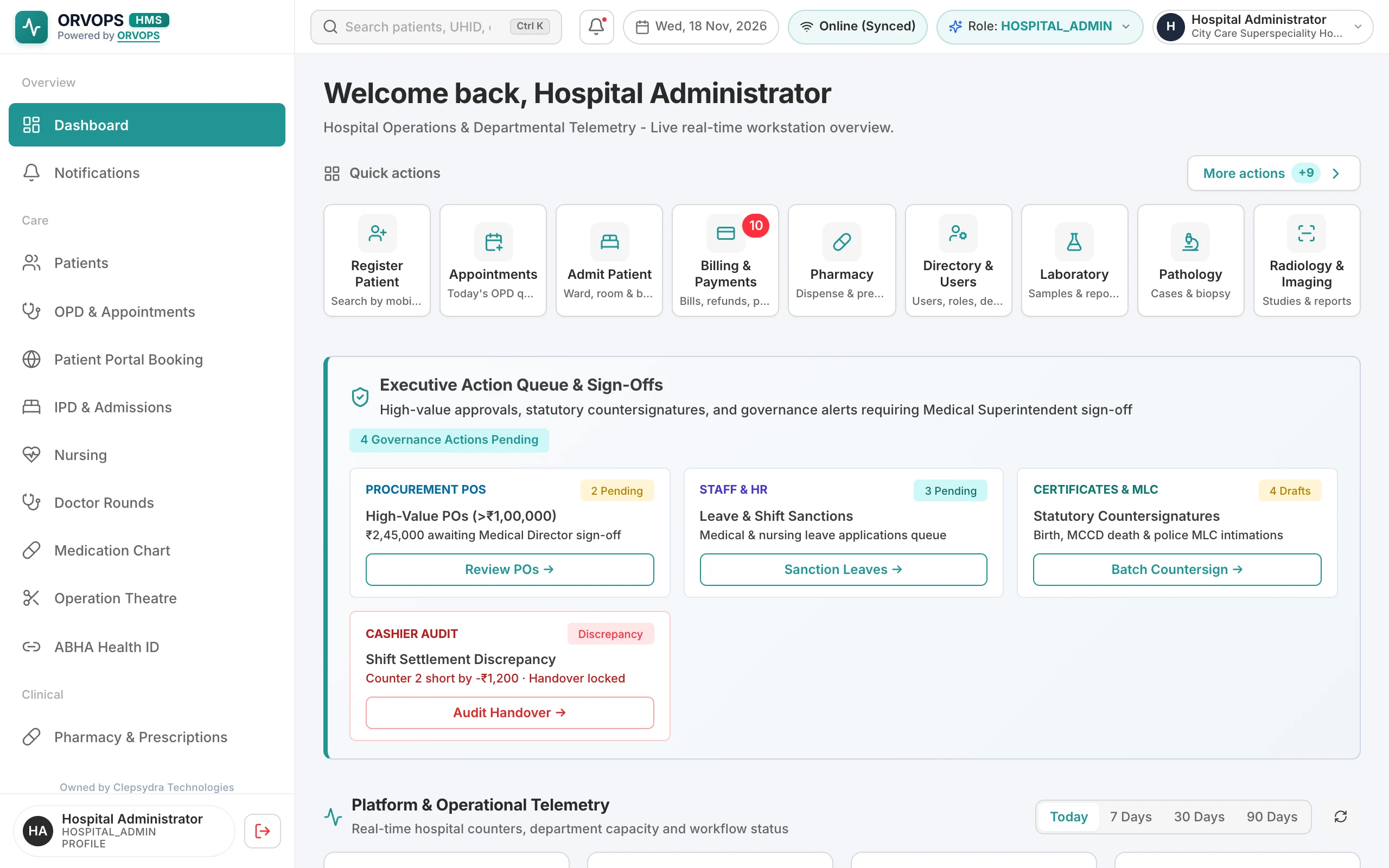
ORVOPS HMS is a multi-tenant hospital management system for the whole patient journey. A registration creates one permanent hospital number. OPD, IPD, operation theatre, nursing, diagnostics, pharmacy, billing, insurance and HR attach to that same record. Every bed move, charge and clinical note is written down, permissioned and auditable.
hms.orvops.com
What is inside
Registration to discharge, pharmacy to payroll — the hospital runs on one record, not five systems.
A backend-generated UHID, duplicate-safe search, ABHA linkage with consent, documents and one clinical timeline. The lab, pharmacy and bill all reference the same person.
Doctor schedules, real slots, appointment states, OPD tokens, vitals, ICD-10 diagnoses, prescriptions and templates — with the prescription flowing directly to pharmacy.
A live ward board with available, occupied, reserved, cleaning and maintenance beds. Every allocation and transfer is a historical row, not an overwritten pointer.
Theatres, surgical teams, ASA grades, laterality, priority, planned duration, cancellation reasons and surgery notes. Blood reservation is visible to the OT.
Laboratory, pathology, radiology and blood bank: sample barcodes, worklists, result entry, verification and signing, critical alerts and audited amendments.
Batch dispensing, FEFO, expiry and stock alerts, supplier returns, purchase orders, GRN and three-way matching — with charges posted as dispensing happens.
Charges are captured where the work happens. Discounts and refunds need a second approver. Insurance, TPA, payments and deposits sit on the same patient ledger.
Employee records, shift rosters, attendance, leave and payroll preparation, kept separate from clinical access and financial approvals.
Registration, consultation and billing keep moving when the line drops. Local changes queue and reconcile when the connection returns.
Database-enforced hospital isolation, 15 roles, separation of duties, soft deletes with audit rows and separate PHI access logs. A hospital can never read another hospital's data.
In the product
Move through the screens that carry a working day in HMS.
The bed board knows its history. Card 1 of 4.
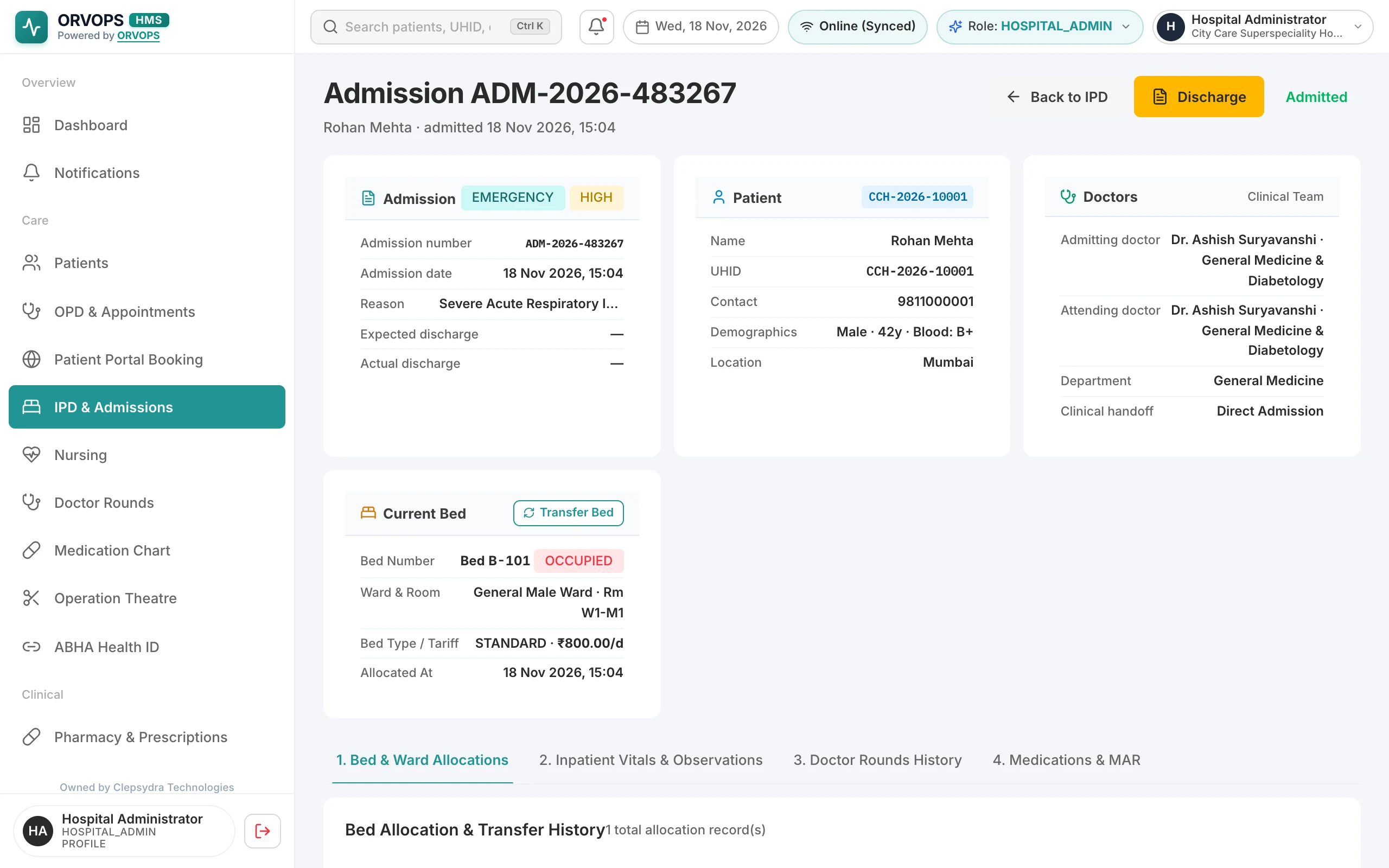
Admissions & beds
Most systems store only the bed a patient is in right now. ORVOPS keeps every allocation and transfer with a timestamp, so occupancy, tariffs, cleaning states and the discharge bill all agree — even after the patient has moved three times.
01 / 04
Modules
Turn modules on as the team is ready. Each one works from the same patient identity, permissions and audit trail.
Screenshots
Every image below is a screenshot of the product — captured from the build, not assembled in a design tool.
Why this product
Features are easy to list. These are the choices that decide whether the system survives a real Monday.
Allocations and transfers are appended, so you can answer which bed a patient was in on any night — and bill the right tariff.
Dispensing, investigations and procedures create chargeable rows as they happen. The bill is a consequence of the work, not a second data-entry job.
The sidebar is convenience. Permissions are enforced again by the backend, and isolation is enforced by the database.
UHIDs, bills, lab orders and receipts come from each hospital's own timezone-aware series. Numbers are never reused.
A figure the screen could not load renders as an em dash, never a confident zero. A failed request and an empty hospital should never look the same.
Clinical and financial records use soft deletes with an audit row. PHI reads are logged separately.
How it compares
A candid look at this product against the way most teams run the same operation today.
8 capabilities compared
| Capability | ORVOPS HMSThis product | Registers & spreadsheets | Typical billing software |
|---|---|---|---|
| One patient record across OPD, IPD, lab and pharmacy | Included | Not included | Partial |
| Bed allocation and transfer history | Included | Not included | Not included |
| Charges captured at the point of work | Included | Not included | Partial |
| Role separation and approval limits enforced below the UI | Included | Not included | Partial |
| Insurance and TPA workflow | Included | Partial | Partial |
| Database-enforced per-hospital isolation | Included | Not included | Partial |
| Offline-tolerant core workflows | Included | Not included | Not included |
| Audit trail for edits, deletes and PHI access | Included | Not included | Partial |
One patient record across OPD, IPD, lab and pharmacy
Bed allocation and transfer history
Charges captured at the point of work
Role separation and approval limits enforced below the UI
Insurance and TPA workflow
Database-enforced per-hospital isolation
Offline-tolerant core workflows
Audit trail for edits, deletes and PHI access
A general comparison of approaches, not a scorecard for a named vendor. Exact features vary by product and deployment.
Who uses it
The same data, shown at the level each person is allowed to act on.
Everything inside their hospital, never the platform.
Assigned patients, consultations, orders, rounds, discharge.
Vitals, care tasks, handovers and medication administration.
Registration, appointments, admissions and bed availability.
Valid prescriptions, batch dispensing, stock and expiry.
Samples, worklists, results, verification and signing.
Bills, receipts, payer balances, refunds and reconciliation.
Employee records, attendance, leave and payroll prep.
Self-service appointments and reports through the portal.
FAQs
Still unsure about something? Ask us directly — the answer will be specific to your operation, not a brochure line.
Ask on WhatsAppYes. Migration is scoped after a data audit: masters, patients, UHID mapping, history and the departments you want live first. We do not promise a blind import; we map the fields that carry clinical or billing risk.
One hospital is the tenant. A group can run multiple tenants with their own ID series, data and configuration. A hospital cannot read another hospital's patients, money or staff.
Departments, roles, tariffs, ID series, templates, approval limits, certificate formats and reports are configurable. Larger screen or workflow changes are scoped as implementation work.
Either. ORVOPS HMS can run on managed cloud infrastructure or your own environment, with HTTPS, backups and an agreed retention policy.
It is phased: masters and registration first, then OPD/IPD, then diagnostics, pharmacy and billing. The timeline depends on data quality, module scope and how many departments go live together. We give you a written plan before work starts.
Yes. Pre-authorisation, claims, settlements, payer balances, payment modes, discounts, refunds and GST-ready bills are part of the revenue cycle.
Core workflows continue locally and queue their changes. When the connection returns, the sync centre reconciles them. The screens tell the staff what is pending instead of showing a false success.
Next step
Tell us what you run today. We will show the screens that match, answer the hard questions and leave you with a clear next step.
The rest of the suite
QR attendance, member plans, tiffin dispatch, rider routes, dues and daily accounts — one console for the whole kitchen.
ExploreInventory & distributionAn append-only inventory ledger with batch expiry, procurement, transfers and GST billing — isolated per organisation at the database.
ExploreHotel managementBookings, room QR, housekeeping, GST billing and staff payroll — an operating system for independent hotels and resorts.
Explore